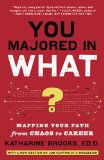
 There are thousands of career, job, and calling books on the market. Some of them are useful. Some of them are good mostly for propping doors. I’m going to call out the ones that are most likely to be interesting and useful to you as you explore what makes you happy and how you can turn that into a career.
What’s this book about?
Katharine Brooks is a career counselor at the University of Texas at Austin, and You Majored in What?: Mapping Your Path from Chaos to Career
But many of the problems she addresses are equally challenging for post-academic career changers whose field of study doesn’t obviously cross over from the ivory tower to the business world: figuring out what career to pursue, mapping out what you have to offer, and translating what you have to offer into terms other people understand.
What makes this book different?
Although the topic isn’t necessarily new and different, two things stand out here: a focus on chaos theory and a visual style of brainstorming and thinking.
When I first encountered the bit about chaos theory, I’ll admit to rolling my eyes. You know, fad topic, applies to everything, yadda yadda. But if we think about chaos theory as a way to describe and interact with systems that are both ordered and too complicated to model, well, it’s true that looks an awfully lot like a life.
Brooks applies chaos theory in an interesting way, too, by boiling its lessons down to three actionable questions: What do you know? What do you not know? What can you learn? Asking — and answering — those three questions can help you take all of that panic and uncertainty and wrestle it into something you can work with while simultaneously expecting the unexpected. Because after all, you really do have no idea how this will unfold.
The other thing that sets her apart is a visually-based style of brainstorming and thinking about career choices. Most of the career books out there are based on linear thinking models like lists, but Brooks relies on mindmaps and other graphic ways of clustering and connecting information, which is nice for those of us who have to see how things connect and yet don’t like drawing messy lines unless we’re supposed to be drawing messy lines. (Why yes, I am a recovering perfectionist. Why do you ask?)
What makes this useful?
In addition to the chaos-theory and visual-brainstorming angles, I appreciated this book for its passionate belief that non-preprofessional degrees are hugely valuable — without falling into the “you can write!” trap that so many books and websites find themselves in.
For example, she talks about “mindsets” as soft skills that are hugely valuable to employers, and mindsets, because we’re so familiar with our own, are precisely the kinds of things we often don’t think to include as we inventory what we can offer.
Not all of it will be useful without some translation — listing what you’ve learned from the different classes you’ve taken is probably not something you’re going to do, but thinking about the big-picture skills and abilities you’ve learned and demonstrated while knocking out a research manuscript while simultaneously tapdancing on the desk to keep those undergrads engaged should be.
But it’s a far more interesting, lively, readable, and doable book than us than most of the ones out there –even if it is aimed at undergraduates.
All links to books in book reviews are affiliate links. You can read more about them here.
Leave a Reply