Escape the Ivory Tower

  • Home
  • Blog
  • Resources
  • Tell Your Story
  • About Julie

November 7, 2010

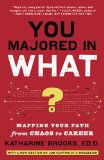
Book Review: You Majored in What?

Book Review: You Majored in What?

There are thousands of career, job, and calling books on the market. Some of them are useful. Some of them are good mostly for propping doors. I’m going to call out the ones that are most likely to be interesting and useful to you as you explore what makes you happy and how you can turn that into a career.

What’s this book about?

Katharine Brooks is a career counselor at the University of Texas at Austin, and You Majored in What?: Mapping Your Path from Chaos to Career is focused on the particular struggle faced by undergraduate students in non-preprofessional majors: English, history, comparative literature, sociology, and every other major that doesn’t come with an obvious entry-level position.

But many of the problems she addresses are equally challenging for post-academic career changers whose field of study doesn’t obviously cross over from the ivory tower to the business world: figuring out what career to pursue, mapping out what you have to offer, and translating what you have to offer into terms other people understand.

What makes this book different?

Although the topic isn’t necessarily new and different, two things stand out here: a focus on chaos theory and a visual style of brainstorming and thinking.

When I first encountered the bit about chaos theory, I’ll admit to rolling my eyes. You know, fad topic, applies to everything, yadda yadda. But if we think about chaos theory as a way to describe and interact with systems that are both ordered and too complicated to model, well, it’s true that looks an awfully lot like a life.

Brooks applies chaos theory in an interesting way, too, by boiling its lessons down to three actionable questions: What do you know? What do you not know? What can you learn? Asking — and answering — those three questions can help you take all of that panic and uncertainty and wrestle it into something you can work with while simultaneously expecting the unexpected. Because after all, you really do have no idea how this will unfold.

The other thing that sets her apart is a visually-based style of brainstorming and thinking about career choices. Most of the career books out there are based on linear thinking models like lists, but Brooks relies on mindmaps and other graphic ways of clustering and connecting information, which is nice for those of us who have to see how things connect and yet don’t like drawing messy lines unless we’re supposed to be drawing messy lines. (Why yes, I am a recovering perfectionist. Why do you ask?)

What makes this useful?

In addition to the chaos-theory and visual-brainstorming angles, I appreciated this book for its passionate belief that non-preprofessional degrees are hugely valuable — without falling into the “you can write!” trap that so many books and websites find themselves in.

For example, she talks about “mindsets” as soft skills that are hugely valuable to employers, and mindsets, because we’re so familiar with our own, are precisely the kinds of things we often don’t think to include as we inventory what we can offer.

Not all of it will be useful without some translation — listing what you’ve learned from the different classes you’ve taken is probably not something you’re going to do, but thinking about the big-picture skills and abilities you’ve learned and demonstrated while knocking out a research manuscript while simultaneously tapdancing on the desk to keep those undergrads engaged should be.

But it’s a far more interesting, lively, readable, and doable book than us than most of the ones out there –even if it is aimed at undergraduates.

All links to books in book reviews are affiliate links. You can read more about them here.

Filed Under: Book reviews, Turning Your Calling Into a Job Leave a Comment

November 4, 2010

Post-Academic Profile: John Fox

Post-Academic Profile:  John Fox

Thousands of people have successfully made the transition from academia — whether as graduate students, postdocs, adjuncts, tenure-line faculty, or tenured faculty — to lives and careers outside the ivory tower.

A Renaissance Man

A few weeks ago, the Chronicle published an interview with John Fox, former anthropology PhD turned writer, explorer, and educator. (If you’re a subscriber, you can read the whole thing here.)

The interview was so interesting — and the interview subject so compelling! — that I’d like to call out here some of the key takeaways for those of you still in the how-do-I-get-out-trenches.

There will not be a Master Plan.

When the interviewer asks him what ties together all of his disparate jobs, he said,

I’ve always loved the quote by Ralph Waldo Emerson that “the voyage of the best ship is a zigzag line of a hundred tacks.” My career since grad school has followed a zigzag course, to say the least. Much as I’d like to pretend it’s been the unfolding of some great master plan, the truth is, it’s come about through a combination of pursuing interests, seizing opportunities, and being pragmatic about making a living.

In other words, even if you start with a Grand Master Plan, it’s probably not going to last. But always taking the next right step — defined as whatever is the most interesting, compelling, exciting opportunity in front of you (which is not necessarily the most lucrative or prestigious), will get you somewhere fascinating and joyful.

Leveraging … anthropology?

You’d think, actually, that Fox would have had a harder time than most academics turning an academic career into a non-academic career. After all, his field was ancient Maya — not something you find everyday jobs in.

But he points out that we tend to undersell ourselves, especially in academia:

The other big lesson I’ve learned is that you can’t define your capabilities too narrowly—to be successful, you need to have an expansive view of yourself and what you have to offer. Ironically, I found academe as a career track to be very narrowing and limiting in that regard. These days, I’m quite comfortable wearing many career hats and learning about and dabbling in other fields. Again, I apply myself as an anthropologist, always the participant observer, always curious about “the other.” Comes in handy.

Even if you aren’t an anthropologist, all of those “soft” skills that helped you succeed in graduate school are things employers outside of academia are desperate for. If you don’t think writing is a significant skill, well, you probably haven’t spent much time reading what passes for communication in a lot of companies.

John Fox does not have superpowers

Okay, he probably does — the same way we all do. We all have unique and particular conglomerations of passions, skills, talents, and curiosities, and that intersection is where your escape hatch is probably located.

It can be easy to dismiss other people’s success outside of academia — they had something special going for them, you’re more ordinary, yadda yadda. But that’s just an excuse. John Fox was just another unhappy academia, and he turned that into a rich and rewarding life. And so can you.

A few comments about comments

I’d love leads on any other post-academics who’ve been successful out there in the wide world. If you know of any, drop me a line!

The whole question of being unhappy in academia — no matter what stage you’re in — can feel fraught. If you’d like to comment but are feeling shy about “being out there,” feel free to make up a persona or comment anonymously. You can also email me directly.

First-time commenters are always moderated (because you wouldn’t believe the spam I get), so if your comment doesn’t show up immediately, hang tight! Chances are, I’m not right on my email.

And most of all, let’s all practice compassion for ourselves and others in this difficult time and space.

Filed Under: Post-Academic Profiles Leave a Comment

November 3, 2010

It’s that time again — Open Office Hours are tonight!

Tonight! 7:30pm! Operators (okay, I) will be standing by. (301) 927-0083.

Here’s how I’ve described Open Office Hours.

Once upon a time, office hours were for us.

When we were overwhelmed, when we were confused, when we were excited, we could march down the hall and take our turn in the old, uncomfortable chair. We could pull our legs up onto the seat, point at books we’d dogeared, ask that question we’d scribbled in the margin of our class notes, plunk down half-written drafts that just refused to cohere.

Sometimes they were big questions, learning-the-discipline questions, and sometimes they were small questions, more about touching base and reassuring ourselves.

And in the best cases, we left refreshed, invigorated, comforted, heard. In the best cases, we left with new direction and new information. In the best cases, office hours were a security blanket, always available even if we didn’t need them right then.

But somewhere along the line, office hours stopped being for us. Maybe they got taken over by newer, younger students whose questions were more pressing and more particular. Maybe we graduated and didn’t have teachers in the same way. Maybe we started offering office hours instead.

Just because we’re all growed up now doesn’t mean we don’t still need to plunk ourselves down in someone else’s office chair now and again and have a good whine or ask that burning question we just can’t for the life of us figure out.

Introducing…

Open Office Hours for Questioning Academics

That’s right — a time set aside just for you to ask questions, tell your story, brainstorm solutions to the things that are troubling you, or just get some sympathy and commiseration.

During Open Office Hours, you can call me with whatever is on your mind — the latest upsetting situation you need to vent about if you’re going to present a polite front, confusion about where your life and your career are going, questions about what you might want to do next, frustrations about your research project or writing progress.

If you aren’t sure what you want to talk about, but you know you’re unhappy, that counts too — give me a ring and we’ll see if we can untangle it just a bit.

It’s something like Speed Coaching — we won’t be able to cover or fix everything, but if we can help one small thing be less painful or confused, then everything else will gain a sense of ease and possibility. And wouldn’t that be nice?

How Open Office Hours works

During the designated time, you can call me at (301) 927-0083. If I’m not on another call, I’ll answer. If the phone is busy, try again in a few minutes — it’s first-come, first-served.

Filed Under: Uncategorized Leave a Comment

« Previous Page
Next Page »

Meet Julie

Want to know what I'm all about? Click here to listen to me get interviewed by Daniel Mullen of The Unemployed Philosopher.

You can also learn more about my history -- Read More…

Myths and Mismatches eCourse

Jo VanEvery and I have put together a free eCourse on the most common myths and mismatches we see in people who are unhappy in academia.

It's one lens through which you can examine your own unhappiness and better diagnose the problem -- which makes finding a solution that much easier.

Find out more by clicking here!

Recent Posts

  • Writing Resumes and Cover Letters? Here Are Some Tips
  • I Still Think Calling Is Important
  • You Need Abundant, Luxurious Self-Care
  • Give Yourself Room to Fall Apart
  • Tip: Ask People About Their Jobs

Site Links

Affiliate Policy

Site Credits

Find Me Online

  • Instagram
  • Twitter

Copyright © 2009–2015 by Julie Clarenbach · All Rights Reserved