You know how there are those lists of the most stressful life events people can undergo? I saw one recently that rated “changing careers” as less stressful than “sex difficulties” and about as stressful as “change in number of arguments with spouse” and “mortgage over $40,000.”
They lie, my friends. Changing careers — or doing anything that changes your very identity, your sense of who you are — is unbelievably stressful. But in the same way that knowing the “normal course” of grief helps us just go ahead and grieve without worrying if there’s something wrong with us, knowing how change happens helps us just go ahead and ride the change without worrying if we’re doing it wrong.
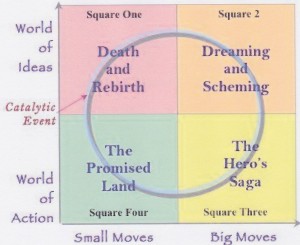
So let me offer to you one model, developed by John Beck for organizational theory and popularized for individuals by Martha Beck, called the Change Cycle.

In this model, nothing much happens until a catalytic event occurs — something, whether internal or external, that changes our sense of who we are. In other words, buying a new spatula isn’t going to trigger this kind of change cycle, but changing careers, getting married, getting divorced, becoming a parent — any of the biggies will do — will.
Once that catalytic event happens, you’re catapulted into Square 1. It’s called Death and Rebirth because what happens in Square 1 is that you have to grieve the you that died (the academic you, the professor you, the whoever you) and start figuring out who you are becoming.
This square is messy, it’s distressing, and it’s uncomfortable, especially to people outside who say things like, “but this is what you wanted!” Yes, you wanted it. Yes, it will be incredible. Yes, it’s fucking hard in the meantime.
Square 1 is about changes that happen inside you — you can go through all of the stuff off Square 1 long before you find another job and turn in your letter of resignation, just because you’ve figured out that what’s happening now isn’t sustainable and you’re actually contemplating doing something else.
Once you’ve got a sense of what’s replacing the original identity — of who you’re becoming — you’re moving into Square 2. Square 2 can often be the most fun for people, because Square 2 is about dreaming big dreams. If there were no constraints, how would this new you manifest? What would it look like? Where would you be?
Square 2 moves from general ideas to actually making the plans to jump into your new life, the new life that is aligned with this new identity. The changes you’re contemplating now are huge, but they’re still in your mind and on paper.
Square 3, on the other hand, is where you actually start making change. You start applying for that new job. You apply for the loan to start the business you’ve always dreamed of. You sit down to write the Great American Novel. In short, Square 3 is where the rubber meets the road, where what’s happening becomes manifest to other people.
But the best laid plans of mice and men don’t always work out, and Square 3 is characterized by trying, failing, and trying again. The first job you apply for, the one that looks perfect, never calls you back. You realized you’ve left out a key step in your business plan. You get fifteen pages into the novel and realize you have no idea what happens next and your characters aren’t sharing. So what do you do? You go back to the drawing board. You figure out what you can change to make it work, and you make the change and make it work.
And eventually, it does work. And when it works, when everything is running smoothly, you’re in Square 4. Square 4 is about the new status quo, about having all systems go, everything humming along. You’ve settled into your new career and you’re happy and valued. The new business starts turning a profit. You finish the novel and sell it to a publisher and you get a contract for another book. Square 4 never lasts, not forever — there’s always another catalytic event — but it’s a lovely place to be until that happens.
The hardest part about the change cycle is that you can’t skip squares. Oh, you can try. I jumped — or tried to jump — right into square 3 with a shiny new career in a shiny new city with a shiny new schedule, but I still had to go back and do the grieving and dreaming of squares 1 and 2 before that new life of mine could really become mine, before I could live it without lingering shame or fear or doubt.
And, as frequently happens when you skip steps, my new career certainly got me out of academia, but it wasn’t really what I wanted to do, so I changed careers again — for the second time in three years. Trust me — it’s easier to go ahead and do them in order.
So if you’re thinking about leaving academia and you’re grieving, that’s exactly what you should be doing. If you’re sitting around daydreaming about the fabulous life you’ll have, the one where you feel appreciated and well-paid and passionate, that’s also exactly what you should be doing.
Changing careers is hard, and I think leaving academia may be especially hard, since we’ve spent years immersed in the stories of the Ivory Tower and most of our adult relationships have been in that context. But there is a pattern, and the painful parts do end, and if you can just hang out and stay present, eventually there’s Square 4, the Promised Land.